
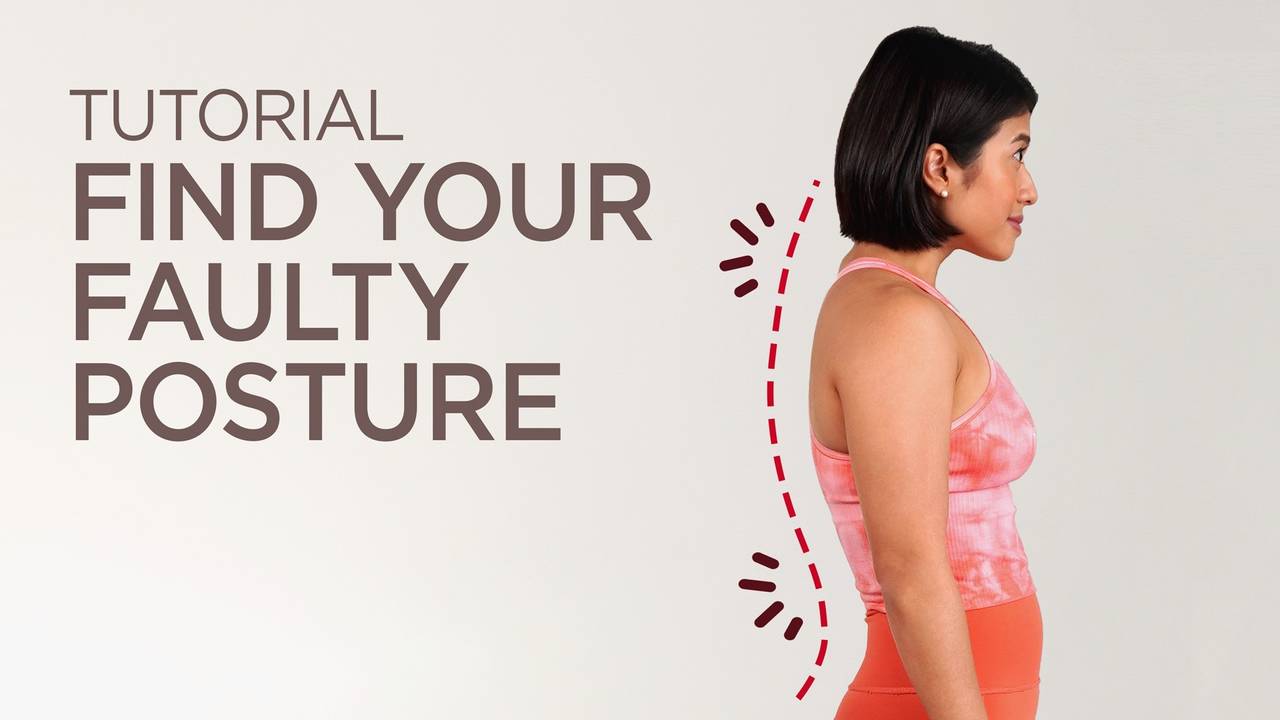
Welcome to Better Posture 1.0. I will teach you how to improve your posture and feel good. Relieving your aches and pains so you can stand naturally, and look confident and relaxed. Our modern lifestyle makes it challenging to keep an ideal alignment and good posture. Leading to much discomfort in your back, neck, hips, and knees. Improving your posture starts with identifying your faulty posture. Faulty posture 1 Hyperlordosis. This is a combination of an increased curve in your lower back and in the middle and upper back. In lower back hyperlordosis, your pelvis is tilted forward (anterior tilt). This is a result of weak abdominal muscles, tight hip flexors, and weak lower back muscles. Leading to the back, neck, hip, and knee pain. Your shoulders may also appear hunched and your head tilted forward. This is called Kyphosis. It can be caused by many factors, including weak thoracic muscles, and tight chest muscles. Faulty posture 2 Flat back posture is a condition in which the natural curve of the lower back has decreased. People with flat back postures often suffer from having weak lower back muscles. Consciously encouraging a more neutral lumbar curve. Having a flat back can be very tiring, leading to fatigue and back pain. Faulty posture 3 Swayback or fatigue posture is a condition where the pelvis and middle spine are pushed forward. Flattening the curvature of your spine. This posture is often seen in people who are overweight or have weak abdominal muscles. This is a passive posture or fatigued posture that takes little energy to maintain. Faulty posture 4 Scoliosis. This is a complex condition. It involves one or more lateral curvatures of the spine. This usually includes the rotation of the vertebrae. We are not going to address this complex condition in this series. Every person’s scoliosis is different, requiring special care and an individual program. Faulty posture 5 There are three main types of genu (knee) abnormalities. Genu recurvatum (also known as hyperextended knees). Genu valgum (also known as knocked knees). And genu varum (also known as bow legs). I have genu recurvatum, where my knees pull backward beyond my natural alignment. As a former dancer, I tend to have very flexible joints. I need to consciously engage my hamstrings by pulling up the back of my knees. It’s also important to keep the front of the knees in front of the ankles when straightening the legs. Genu valgum, on the other hand, is a condition where the knees touch and the feet are separated. Genu varum is similar to genu valgum, but instead of the knees touching, it’s the feet that touch while the knees are separated. I hope you can see and recognize similarities in your current posture. Understanding what is happening in your body, is an important first step. To have good alignment and body mechanics, you must give your body the correct tools. I will teach you how to breathe, passive and active. Training your deep abdominal muscles Transversus abdominis. Building your deep back muscles and functional hip flexors to achieve a strong core. You need to build strength and flexibility to control your posture with ease. In order to have good alignment and mechanics, the body must have the correct tools. You need to learn how to breathe properly and train the deep abdominal muscles Transversus abdominis, deep back muscles, and functional hip flexors to achieve a strong core. Not to forget you need to be flexible too. A good posture requires a neutral spine. A neutral spine is when the three curves of the spine are in alignment. The cervical curve is inward, the thoracic curve is outward, and the lumbar curve is inward. A neutral pelvis position is necessary to achieve a neutral spine. We will find your neutral pelvis position during class. Having a Neutral spine is incredibly important. It allows for even weight distribution and proper shock absorption throughout the spine. This leads to less wear and tear on the joints, discs, and ligaments, and helps to prevent injuries. When the spine is out of alignment, it can cause muscle fatigue, joint pain, and nerve compression. Ideal posture is relative to a Plumb Line when viewed from the side. The following points should fall along this Plumb Line when ‘ideal alignment’ is present. Ear lobe, bodies of the neck, shoulder joints, halfway through the trunk, greater trochanter of femur – the protruding bone on the side underneath the hips, slightly forward to the mid-line of the knee, slightly forward to the ankle bone (lateral malleolus). We also need to check good alignment from the front and back view, looking for symmetry of the body. Observe the level of the ears, shoulders, space between the arms and the side curve of the spine, the hip bones, the knees, and the feet. Alright, let’s get ready to begin the class. I will see you on the mat

Leave a Reply
You must be logged in to post a comment.